21 December 1963
Bloody Christmas
A police stop in Nicosia ends in two deaths and sets off weeks of fighting. Most of the victims are Turkish Cypriots, and about 25,000 are displaced.
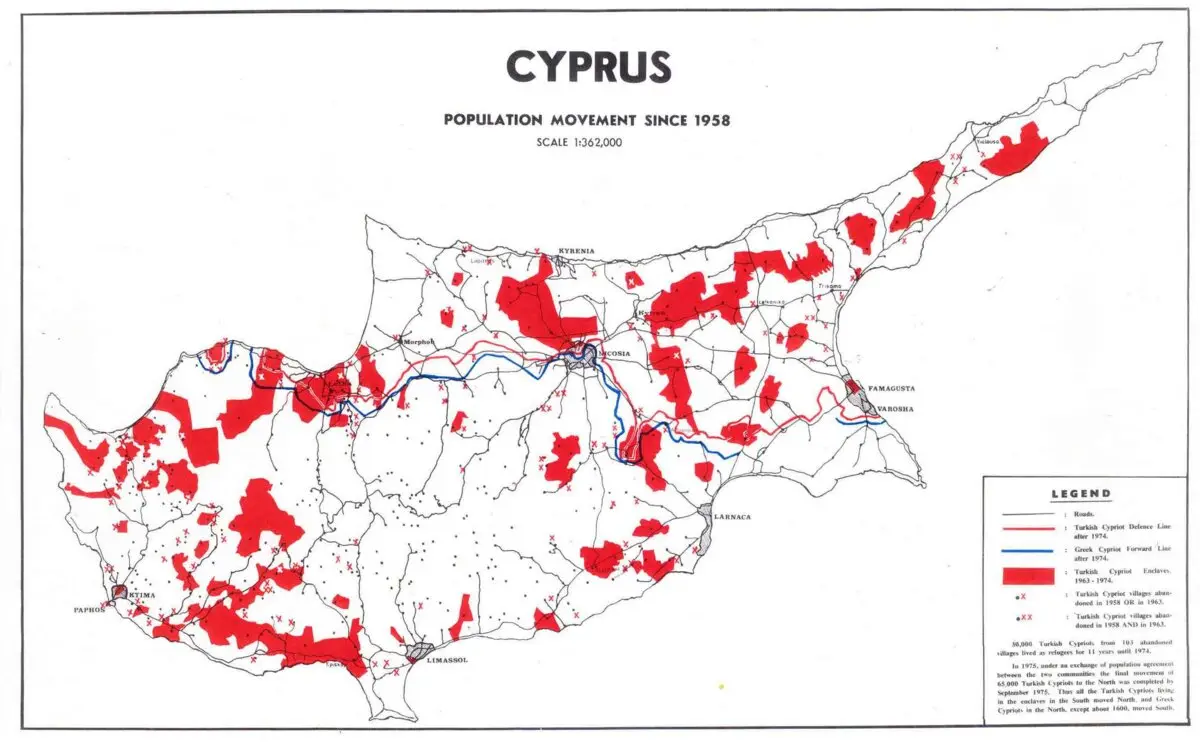
By December 1963 the argument over Makarios’s thirteen amendments had left both communities tense and armed, with underground groups on each side. In the early hours of 21 December, Greek Cypriot police stopped a taxi carrying Turkish Cypriots near the old Venetian walls of Nicosia and asked to check identity papers. A crowd gathered, shots were fired, and two Turkish Cypriots, Zeki Halil and Cemaliye Emirali, were killed.
Within a day there was gunfire across the capital, and the fighting spread to Larnaca and other districts. Greek Cypriot irregulars led by Nikos Sampson attacked the Turkish Cypriot suburb of Omorphita (Küçük Kaymaklı), and on 24 December the wife and children of Major Nihat İlhan were among those killed in the Kumsal district of Nicosia. Armed groups also took hostages. Turkish jets flew low over Nicosia on Christmas Day as a warning, and Britain, Greece and Turkey agreed to a joint truce force under British command. On 30 December Major General Peter Young drew a ceasefire line across a map of Nicosia in green chinagraph pencil, the origin of the Green Line.
Researchers relying on Richard Patrick’s study record 364 Turkish Cypriots and 174 Greek Cypriots killed between December 1963 and August 1964, with the heaviest losses in the first weeks. About 25,000 Turkish Cypriots, roughly a quarter of the community, left their homes, and Turkish Cypriots abandoned or evacuated 24 of their own villages and their quarters in 72 mixed villages. Between 1,500 and 2,000 Greek and Armenian Cypriots were also displaced, mostly from Nicosia neighbourhoods. A UN report in 1964 counted 977 Turkish Cypriot homes destroyed and about 2,000 damaged or looted.
The two communities remember these weeks differently. Turkish Cypriots call them Kanlı Noel, Bloody Christmas, and mark 21 December each year. Official Greek Cypriot accounts have often described the period as a Turkish Cypriot rebellion against the lawful state, while many Greek Cypriots simply refer to “the troubles”. Scholars from both communities, among them Olga Demetriou and Niyazi Kızılyürek, have since argued that school textbooks gave little room to the fact that most of the dead were Turkish Cypriots.