16 August 1960
Cyprus Independence
The Republic of Cyprus is born with a power sharing constitution between Greek and Turkish Cypriots. Britain keeps two sovereign military bases.
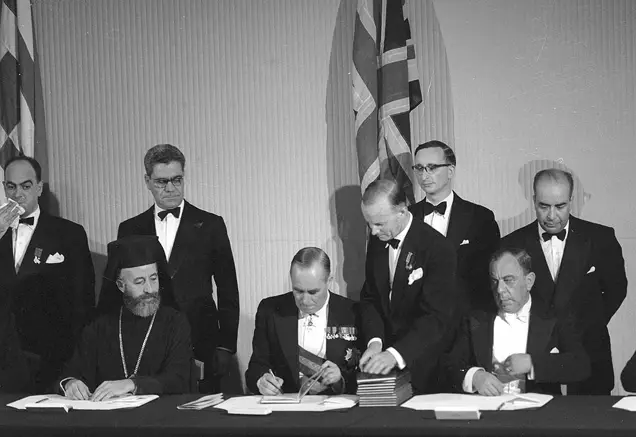
At midnight on 15 to 16 August 1960 British rule in Cyprus came to an end after 82 years. Archbishop Makarios III and Dr Fazıl Küçük, elected the previous December, took office as president and vice president of the new Republic of Cyprus.
The state rested on the Zurich and London Agreements of 1959 and on a constitution drafted to protect both communities. The president had to be a Greek Cypriot and the vice president a Turkish Cypriot, each elected by their own community and each with a veto over key decisions. The Council of Ministers had seven Greek Cypriot and three Turkish Cypriot members. The House of Representatives had 50 seats, 35 elected by Greek Cypriots and 15 by Turkish Cypriots, and changes to electoral, municipal and tax laws needed separate majorities in each community. The civil service was to be staffed in a ratio of 70 to 30, and a planned army of 2,000 in a ratio of 60 to 40. Separate communal chambers handled religion, education and culture, and a Supreme Constitutional Court had a Greek Cypriot judge, a Turkish Cypriot judge and a neutral president from abroad. Key parts of the constitution could not be amended.
Britain kept two Sovereign Base Areas, at Akrotiri and Dhekelia, covering about 256 square kilometres. Greece and Turkey were allowed to station 950 and 650 troops, and with Britain they became guarantors of the new state under the Treaty of Guarantee. Parliamentary elections on 31 July 1960 gave Makarios’s supporters 30 of the Greek Cypriot seats and AKEL 5, while Küçük’s supporters took all 15 Turkish Cypriot seats. Cyprus joined the United Nations in September 1960 and the Commonwealth in 1961.
The two communities came to independence with different feelings. For many Greek Cypriots it fell short of the union with Greece they had sought. For many Turkish Cypriots it offered guarantees but not the partition their leaders had pressed for. The safeguards that gave each side security also gave each side the power to block the other. Disputes over taxation and separate municipalities soon followed, and in 1961 the republic was left without tax legislation. By the end of 1963 the power sharing system had collapsed.