c. 2400 to 1100 BCE
Bronze Age Copper Trade
Copper from the Troodos mountains makes Bronze Age Cyprus a major Mediterranean supplier. The Latin word for copper comes from the island's name.
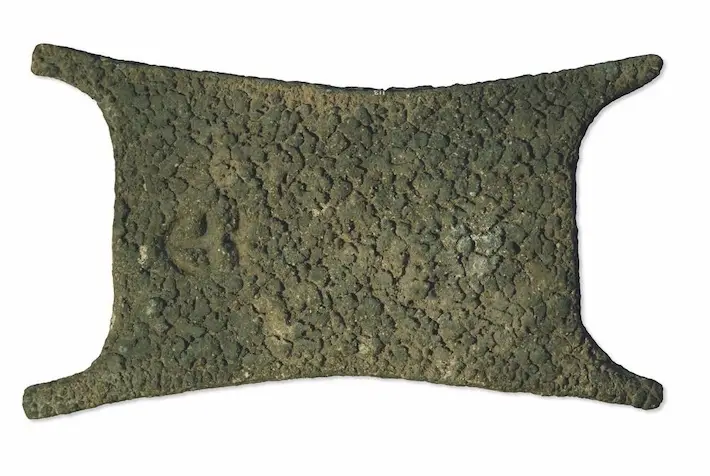
Cyprus sits on some of the richest copper deposits in the ancient world, in the foothills of the Troodos mountains. Islanders were making small copper objects in the Chalcolithic, or Copper Age, which lasted until about 2500 BCE, but metal stayed rare for a long time. One of the oldest finds is a simple chisel from Erimi.
Things changed around 2400 BCE, when newcomers from Anatolia, known to archaeologists as the Philia culture, arrived. They brought the plough, rectangular mud brick houses, cattle and donkeys, and settlement began to shift towards the copper bearing hills. Through the Middle Bronze Age (about 1900 to 1600 BCE), imports from Crete, Anatolia, Syria and Egypt show the island trading more widely.
The real boom came in the Late Bronze Age, from about 1600 to 1050 BCE. Copper was smelted on a large scale and cast into heavy slabs called oxhide ingots, usually weighing 20 to 30 kg. These turn up from Sardinia and Sicily to Crete, Egypt and central Anatolia. A ship that sank off Uluburun, on the Turkish coast, around 1300 BCE was carrying roughly ten tonnes of copper, including 317 oxhide ingots. Lead isotope studies link many later ingots to Cypriot ore, especially around the Apliki mine, although some researchers question how reliable that method is.
Texts from the period speak of a copper rich land called Alashiya, and many scholars identify it with Cyprus. Letters found at Amarna in Egypt, from the mid 14th century BCE, record hundreds of talents of copper sent from Alashiya to the pharaoh. Cities such as Enkomi, near modern Famagusta, grew wealthy on this trade, and the Pharaoh Thutmose III claimed the island as a conquest around 1500 BCE.
The island’s name lives on in the metal itself. The Romans called copper Cyprium aes, “Cyprian metal”, which became cuprum in Late Latin and eventually the English word copper. The chemical symbol Cu comes from the same root.