c. 9000 to 5200 BCE
First Neolithic Settlements
Farmers from the Levant settle Cyprus around 9000 BCE. Villages such as Khirokitia show a settled farming society thousands of years before pottery.
People reached Cyprus long before anyone farmed there. Hunters were visiting the south coast by around 11,000 to 10,000 BCE, at a time when the island was still home to dwarf hippos and dwarf elephants. Reaching Cyprus meant crossing open sea, so even these first visitors had boats and some skill at navigation.
Farming arrived soon after it emerged on the mainland. At Klimonas, in the south of the island, French archaeologists found a village dating to about 9100 to 8600 BCE, the oldest known farming settlement on any Mediterranean island. Its people grew emmer wheat brought over from the Levantine coast, kept dogs and cats, and hunted a small wild boar native to Cyprus. At the centre stood a half buried mud brick building about 10 metres across, probably a communal store for the harvest. Settlers in this period also brought sheep and goats across the water, probably with pigs and cattle too, along with einkorn, lentils, peas and beans.
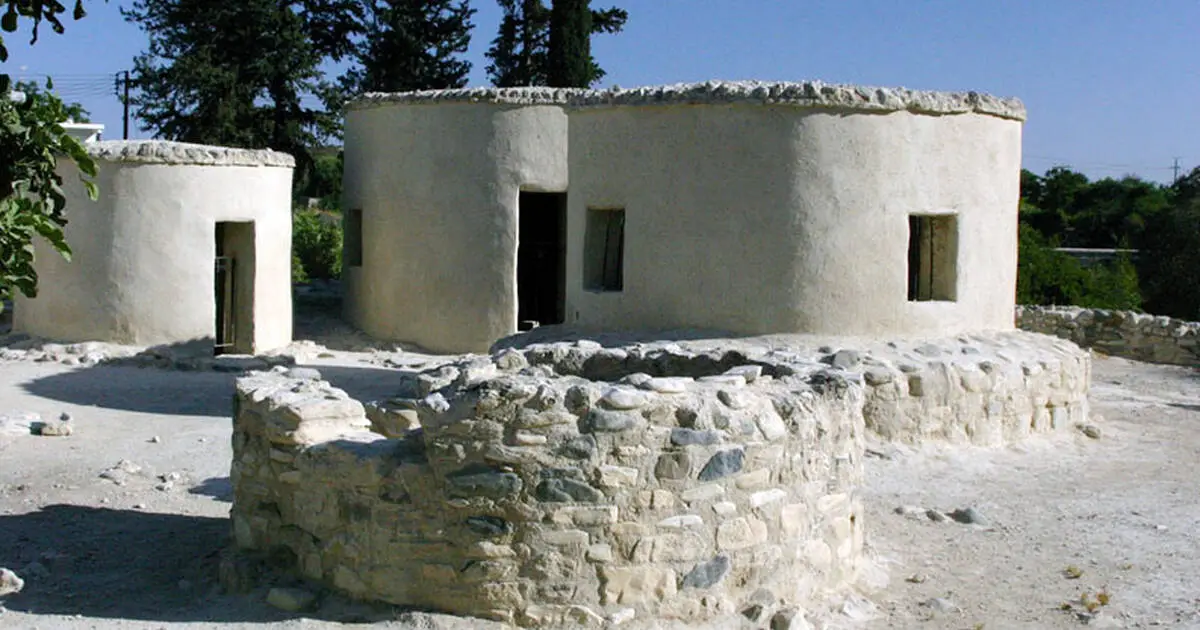
The best known site of the period is Khirokitia (Choirokoitia), on a hillside above the Maroni river in the Larnaca district, about 6 km from the sea. It was discovered by Porfyrios Dikaios of the Department of Antiquities in 1934 and has been excavated by a French mission under Alain Le Brun since 1977. The main settlement dates to the 7th millennium BCE. Its people lived in round houses of stone and mud brick, grouped around small courtyards, inside a perimeter wall. They buried their dead in pits beneath the floors of their homes; more than 240 burials have been found. They farmed cereals and pulses, herded sheep, goats and pigs, hunted fallow deer and fished. They had no pottery, which is why archaeologists call this the Aceramic Neolithic.
Around the middle of the 6th millennium BCE Khirokitia was abandoned, for reasons no one has yet explained, and the site stayed empty for close to a thousand years. UNESCO, which added it to the World Heritage List in 1998, describes it as one of the most important prehistoric sites in the eastern Mediterranean and a record of how farming spread from the Near East towards Europe.