1571
Ottoman Conquest of Cyprus
Ottoman forces take Cyprus from Venice, capturing Nicosia in 1570 and Famagusta in August 1571, beginning just over three centuries of Ottoman rule.
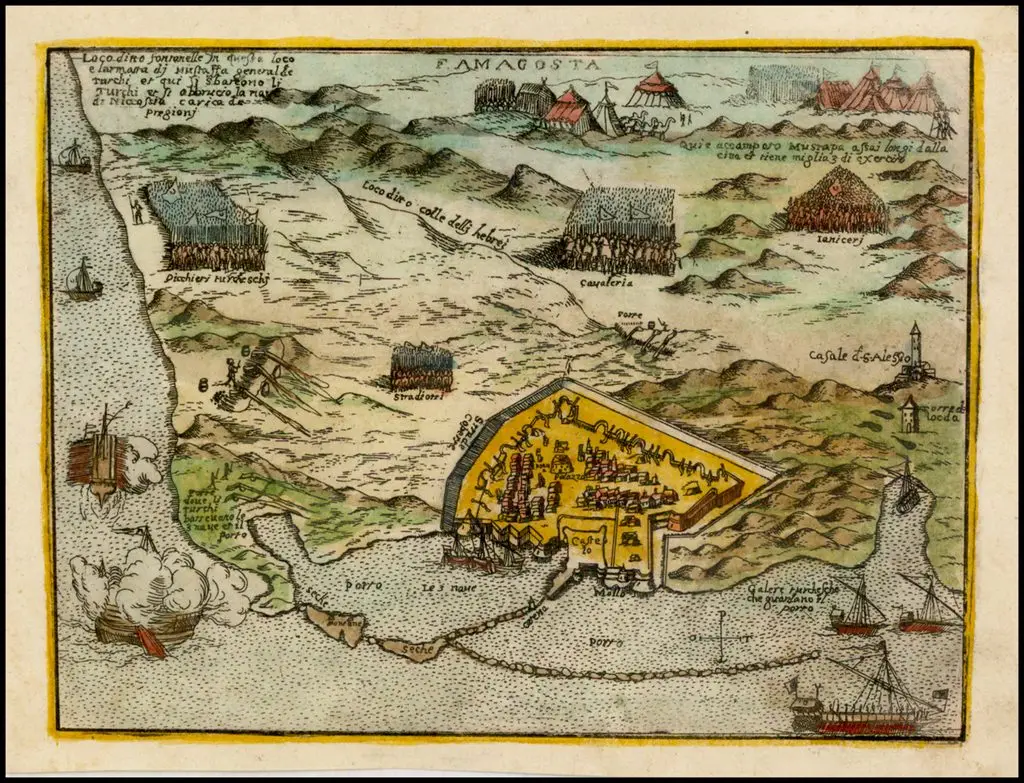
By the 1560s Cyprus was a Venetian outpost surrounded by Ottoman coasts. Its harbours sat on the sea route between Istanbul, Syria and Egypt, which made it a natural target for an expanding empire. In 1570 the Ottoman government decided to take it.
A large Ottoman army under Lala Mustafa Pasha landed in early July 1570 and met little resistance on the coast. Nicosia, protected by its Venetian walls, was besieged from late July and fell on 9 September 1570. Contemporary accounts describe the killing of around 20,000 of its inhabitants, with many survivors taken as slaves. Famagusta held out much longer. Its garrison of roughly 8,500 men under Marco Antonio Bragadin endured months of siege and heavy bombardment before surrendering on 1 August 1571, once food and ammunition ran out. The terms allowed the defenders to leave, but Bragadin was put to death after the surrender. The siege cost the Ottoman army very heavy losses too. Venice formally gave up the island in the peace treaty of 1573.
The new rulers reshaped the island’s religious life. The Latin Church, which had dominated since the Crusader era, was in effect dissolved and several of its churches became mosques. The Greek Orthodox Church, long subordinate to the Latins, was restored as the only recognised Christian church, and its archbishop and bishops were allowed to return. Many Orthodox Cypriots had resented Venetian rule, and this change shaped their relationship with the new administration.
The Ottomans also settled Muslims on the island. Soldiers received land grants on condition that they stayed, and a decree of 24 September 1572 ordered one household in ten from several Anatolian provinces, mostly craftsmen and farmers, to move to Cyprus in return for tax exemptions. Conversion to Islam added to the Muslim population over the following century.
Under the Ottoman system people were governed largely through their religious community rather than by ethnicity, with the Orthodox hierarchy acting for Christians. Land grants to settlers became the nucleus of the island’s Turkish community, and the arrangement lasted until Britain took over administration in 1878.